Upgraded Carrot Halwa (No sugar, no ghee)
When we cook a dessert with a vegetable, it makes us feel good. But if we smother the vegetable with ghee and sugar, are we really doing ourselves a favor?
What is Carrot Halwa? Why do you want to ‘healthify’ it?
To make traditional carrot halwa, you take grated carrots, ghee and sugar, keep stirring it on heat to a point where most of the water evaporates. Throw in a few nuts for crunch and aromatics like cardamom for flavor and you have a delicious carrot halwa. However, in most cases, the reduced carrots simply act as a vehicle to consume a concentrated concoction of yummy fats and sweetness.
If you are the type of person who takes a small amount of dessert, that too only occasionally, then don’t worry. You can go ahead and eat the traditional version. If you already are a beacon of self-control, or genetically blessed to hate desserts, then you have clicked the wrong channel, my friend:). Please carry on with your disciplined lives. But, for the rest of us, who are constantly struggling to lead healthier lives, this is an option to try/tinker with.
Health Upgrades
1) Raw carrots instead of cooked carrots
If you are thinking ‘Whoa!!, slow down there Swetha, I did not sign up for raw carrots”, I understand. But, hear me out. If there is any vegetable that makes the whole cooked - raw transition super easy, it is carrots. Carrots have a natural sweetness that makes it easy to forget you are eating a raw vegetable.
The reason the raw version is healthier is that the water content is retained. When you cook the carrots down in regular halwa, it gets dry and dehydrated, To make up for that dryness, we add a lot of ghee to make it moist and smooth.
2) Dates instead of sugar:
The dates have some fiber and minerals (nothing that is mind-blowing levels, but better than having zero in sugar). The dates also provide stickiness which brings the halwa together.
3) No ghee (but it is also not fat free on purpose)
Since I am not cooking it on the stove, I am not reducing it with ghee. However, I have added a variety of nuts (almonds, pistachios and walnuts) for the crunch and healthy fat factor. Fats and fiber in a meal reduce the rate of digestion and the conversion slowly into sugar.
Time Upgrades
There is no need to slave over the stove to reduce the halwa. This is a quick and easy chop and blend version.
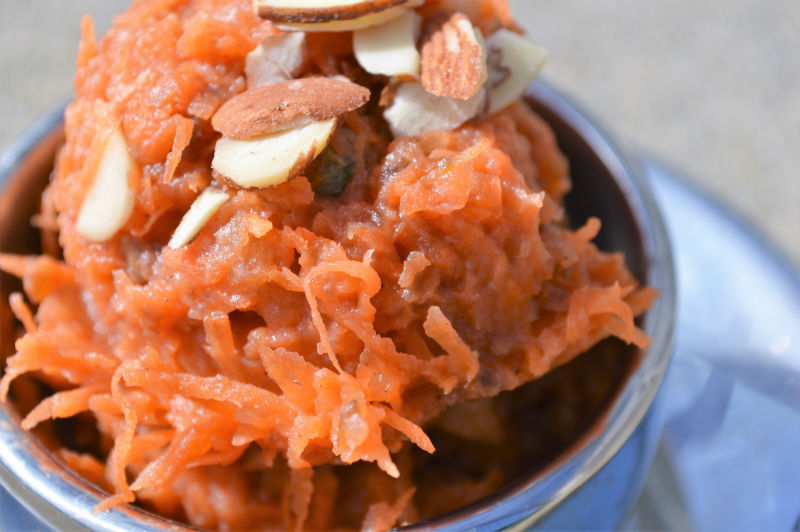
Upgraded Carrot Halwa Recipe
Ingredients (Makes 4 servings)
- 1 cup dates
- 1.5 cup finely shredded carrots
- 3 tsp milk powder (Vegan substitute - almond meal or coconut milk powder)
- 3/4 tsp elaichi powder
- 1/3 cup chopped nuts (walnuts, almonds, pistachio)
Instructions
-
Add 1 cup dates to the food processor and run it till becomes a thick paste. (If you don’t have a food processor, try it in a mixie (blender) without adding water, if possible. Since we are not going to heat the halwa, try to avoid extra moisture as much as you can.)
-
Transfer the paste to a stand mixer or use your good old god-given mixer (a.k.a. hands) to blend the items below
-
Add the shredded carrots (the more finely shredded, the better).
-
Add elaichi powder
-
Add milk powder for the creamy effect. If you want to keep it vegan, use almond meal or coconut milk powder as alternatives.
-
Add the chopped nuts
Ta-da!! Upgraded Carrot Halwa ready
Step by Step Photos
-
Make a date paste
-
Add elaichi, shredded carrots to the date paste in a mixer
-
Add milk powder, chopped nuts and blend
-
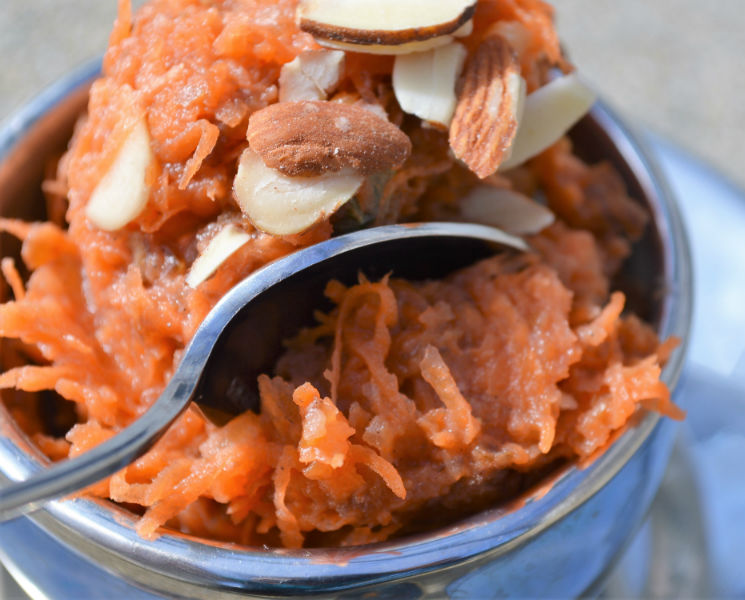
Get ready to dig in.
Additional Resources
There are many nutritional papers that discuss “cooked vs raw” vegetables debate and monitor changes in fiber, vitamins and minerals in both versions. For me, the takeaway message is that you should eat MORE vegetables, in general. Having a combination of both cooked or raw would also be highly beneficial.
Below are some links that provide expert information for people who want to learn more on this topic.
https://www.scientificamerican.com/article/raw-veggies-are-healthier/
https://www.youtube.com/watch?v=LylsVQ8HFIw
https://www.hsph.harvard.edu/nutritionsource/carbohydrates/carbohydrates-and-blood-sugar/